

Updated November 2026: This guide combines my original 2013 experience with my expanded 2014 photo tutorial. My historic aloe, witch-hazel and oil mixture is documented as a personal experience, not a medically tested formula. Ask your maternity care team before applying DIY ingredients to healing tissue.
Looking for a padsicle recipe before your baby arrives? A padsicle is a chilled or frozen maternity pad that some parents prepare for short-term perineal comfort after vaginal birth. Below you’ll find the eight-step method I photographed while I was 35 weeks pregnant in 2014, alongside updated cautions about ingredients and safer cold-pack alternatives.
Padsicle recipe: the quick version
My original 2014 supplies: Unscented overnight pads, aloe vera gel, witch hazel, a spoon, a baking dish, and a freezer bag. Those are ingredients from my personal historical tutorial, not a medically validated formula.
- Unwrap an overnight pad while keeping its backing and wrapper.
- Place it in a clean dish. My original version spread aloe vera gel on the pad and added witch hazel.
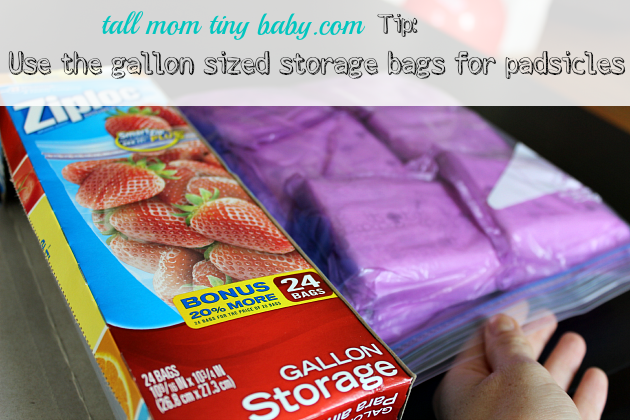
- Refold the pad carefully, return it to its wrapper, and put several wrapped pads in a sealed freezer bag.
- Freeze until chilled or frozen. Ask your maternity care team whether a homemade product or a plain cold pack is appropriate for your recovery before using one.
Important: Cold packs are generally intended for brief sessions, not hours of continuous wear. The American College of Obstetricians and Gynecologists (ACOG) suggests 10–20 minutes at a time for perineal cold packs. Avoid putting something painfully frozen directly against sensitive skin, and do not add essential oils or other ingredients unless your clinician approves.
Want the full photo tutorial? Jump to Mary’s original eight steps, or read common padsicle questions and safety tips before deciding what to make.
Getting ready for life after birth?
Once you have your comfort supplies sorted, these Minute With Mary resources can help with everything else:
- Postpartum preparation checklist — bathroom supplies, appointments, and real-life support
- Bathroom basket and postpartum cart essentials — keep useful items close by
- How to feel like yourself after baby — small personal rituals, identity, and emotional wellbeing
Read the complete postpartum recovery guide for the bigger health and recovery picture.
A perfectly sweet southern mother in law came into town a few days before her granddaughter was born. She was tidying up the soon-to-be new parents house, and began to put away some frozen items she had bought at the supermarket. She opened the freezer and was shocked to find feminine careproducts in bags, clogging up the freezer.
The mother in law carefully approached her pregnant daughter in law, wondering if pregnancy brain had truly taken over. She was convinced that if she were to look, she would find Ben and Jerry’s “Cherry Garcia” underneath the bathroom sink. When she asked her pregnant daughter in law what was in he freezer. The mom-to-be turned around with a smile and said, “Padsicles!” (This story is completely true btw – the names have been omitted to protect the innocent 🙂 )

The night I made padsicles before my baby arrived
I began making my own padsicles one night at our dining room table when I was 35 weeks pregnant. Tall Dad came home from work to find my supplies spread out everywhere. I was blasting Michael Giacchino’s beautiful LOST (season 6) soundtrack, carefully smothering gels and liquids all over menstrual pads.
He thought I had finally lost my mind. I had enough Aloe Vera gel and menstrual pads strewn about my apartment that I could’ve taken care of every female on spring break for the next decade. But, I hadn’t lost my mind.
In fact, what I was doing was brilliant. The padsicles felt soothing during my recovery. I can’t know whether that homemade mixture changed how fast I healed, but I remember being glad I’d prepared something comforting.
In 2014, padsicles were the number one item I recommended to pregnant friends. They are cheap, easy to assemble, and you make them when you are about 35 or 36 weeks pregnant. Padsicles are kept in your freezer, and are used when you return home from the hospital with your newborn baby.
When you have a newborn, you are a busy bee. You are feeding, changing diapers, swaddling, shushing, going to doctors appointments, fitting in visits from family and friends….oh, let’s not forget those minor details of *hopefully* sleeping and eating.
As such, I truly believe in simple, yet effective, preparation for a newborn baby. Tall Dad always says, “less is more.” Much to my chagrin – he’s actually right. I recommend only a few items for your maternity hospital bag, having a short list for newborn necessities, and stocking up a new mom-to-be with proper medicine, feminine care products, as well as fun snacks for those midnight feeding sessions.
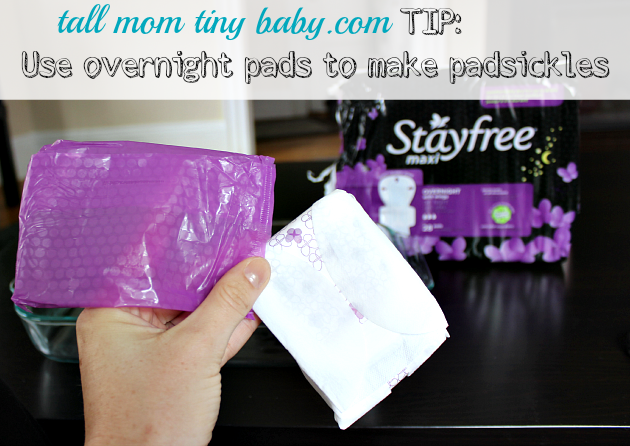
A new mom doesn’t have time to worry about the mess of afterbirth, (aka – your biggest period ever.) New moms also aren’t allowed to wear tampons for a while, so they should stock up on super efficient overnight pads – like Stayfree Overnight – which you can pick up at your local Walmart. (Historical note: a 2014 Walmart promotion was mentioned here in the original post; please don’t assume that offer is still valid.)

How to make padsicles: my original 2014 photo tutorial
Before you try it: This is the original DIY method I used, including ingredients that might irritate healing skin. Check with your maternity care team before following it. For information on cold packs and witch-hazel pads, see ACOG’s postpartum comfort guidance.
Want to know how to make these padsicles? You’re in the right spot. Read on, my friend:
I like to use overnight pads to make padsicles. You will also need some aloe vera, witch hazel, and gallon sized ziplock bag. Grab a baking dish (to keep your table from getting yucky with aloe vera and witch hazel) and a spoon. Alright – let’s make some padsicles!


side note: I wish this could look prettier. Menstrual pads covered in green goo aren’t terribly pretty to look at. Pinterest might like it better if it had glitter and was pretty, but alas, we need to keep things simple here folks.


Updated guidance: This was Mary’s original 2014 preparation. Ask your maternity care team before using a homemade padsicle. If an approved cold pack feels painfully hard or cold, don’t place it directly against sensitive skin; use a clean barrier and follow brief application times instead of wearing a frozen pad for hours.
If your friend is pregnant and hasn’t made padsicles yet, please be sure to share this page with her. Maybe the two of you can do it as an arts and crafts night together.
Okay, it isn’t really artsy, but she will totally thank you in the end.
Or, give it to a new mom as a gift in a new mom survival kit.
Oh and don’t forget —

Until next time friends,

Padsicles FAQ: what to know before making a batch
When should I make padsicles?
I made my own when I was about 35 weeks pregnant. If you want to prepare ahead, ask your maternity care team what they recommend and whether homemade ingredients make sense for you. You do not need to prepare padsicles to have a well-stocked postpartum recovery kit.
Do padsicles still absorb postpartum bleeding?
A pad’s absorbency can change when it is soaked with added liquids or gel. My original method used overnight pads, but an oversaturated homemade padsicle may be less practical for managing bleeding. Keep regular clean postpartum pads available and change them as directed by your care team.
Do padsicles need witch hazel or aloe vera?
No. Those were ingredients in my 2014 version, not essential ingredients in all postpartum cooling methods. For a simpler approach, University College London Hospitals describes a sanitary pad moistened with water and chilled, with a clean dry barrier between the cold pad and skin. Ask your clinician what is suitable, particularly if you have stitches, broken skin, or sensitive skin.
How long should I wear a padsicle after birth?
Use a cold pack only for short sessions unless your clinician tells you otherwise. ACOG recommends 10–20 minutes at a time for perineal ice or cold gel packs. Do not follow online suggestions to wear a frozen pad continuously for hours.
Are homemade padsicles better than postpartum ice packs?
Not necessarily. Homemade padsicles can be convenient to prepare ahead, but ingredients may irritate healing skin, and heavily soaked pads may be messy. A ready-made cold pack or a simple chilled pad can be easier to use. Compare the options in our padsicles versus postpartum ice packs guide.
When should I call my maternity care team?
Seek medical advice promptly if pain is worsening rather than improving, a wound looks infected, you develop a fever, or bleeding is unusually heavy. A padsicle is a comfort measure, not treatment for complications. For broader recovery information, see our postpartum recovery guide and your own discharge instructions.
The original 2013 padsicles story
In May 2013, after my doula suggested preparing frozen pads before birth, I documented the process. Below is my original story and photo archive. The ingredient mixture is a historical record, not a currently recommended medical recipe; follow the updated guidance earlier in this article.
Open my original 2013 story and photographs
Making a baby is fun! It’s heart warming, sexy and thrilling through every stage of the pregnancy.
But, let’s be honest with each other, shall we? I try to keep the information on this blog unfettered and unfiltered. All real talk, all the time. Good, bad and ugly.
So, let’s get to something no one ever really talks about during their wonderful pregnancy experience…
Birthing a baby can sometimes be a different experience for everyone. But it is the same for everyone in one specific way – the long healing process.
A couple of weeks before my tiny baby arrived, our doula recommended that I prepare and freeze some padsicles. Never heard of a padsicle before? Neither had I. So I scoured Pinterest, took a trip to CVS, and got to work.

What are padsicles?
In my original 2013 tutorial, I used sanitary pads with aloe vera and witch hazel, then froze them for postpartum comfort. They felt soothing to me during recovery. That’s my personal experience, rather than evidence that a homemade mixture can speed up healing.
My original 2013 padsicle preparation: the photo archive
So if you, or a loved one, is about to push out a tiny (or not so tiny) baby, here are the steps I followed back then. The ingredients below are preserved from my original experience; check with your own care team before using any homemade mixture on healing tissue.
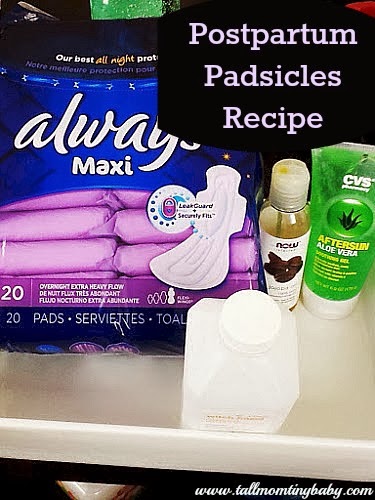
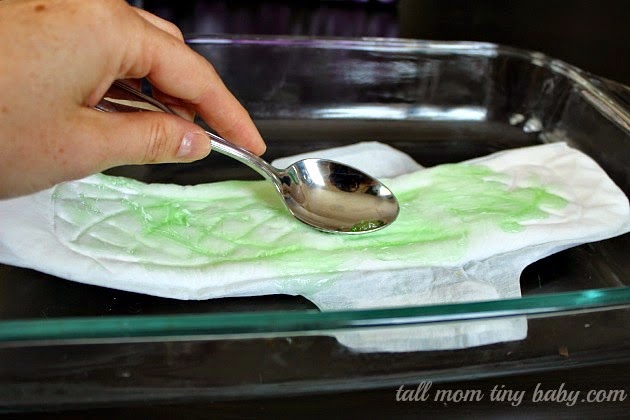
2. Open the pads, but keep them on their backing plastic, because you will need to re-wrap them. Next, pour two tablespoons of witch hazel over the pad, a tablespoon or so of aloe vera, and about a teaspoon of oil.

Mush it all together inside the pad.

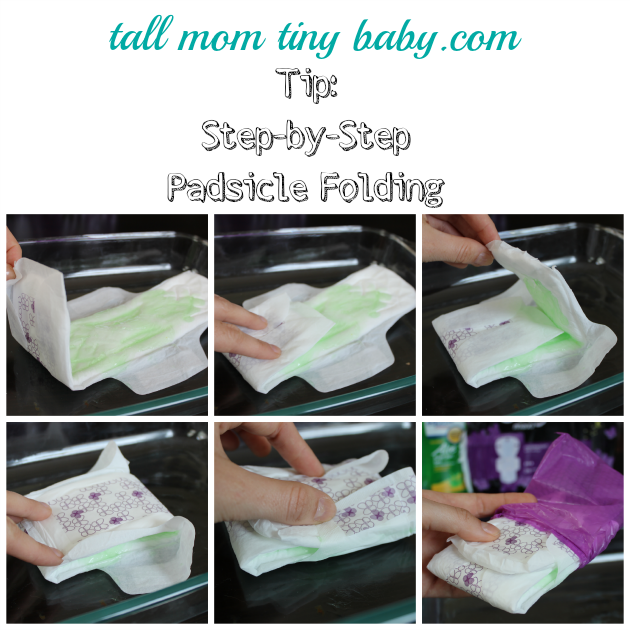

4. In 2013, I tucked the prepared pads into my freezer for after the birth. This is a record of what I did then, rather than current instructions for applying a frozen pad. Ask your maternity care team about suitable cold packs and short application times, and keep regular absorbent postpartum pads available.

A practical note for today’s expectant parents
Getting ready can feel like a lot, especially when every checklist insists you need another product. Mary appreciated having her padsicles prepared in 2014, but birth and recovery vary from person to person. Start with your care team’s advice, regular maternity pads, and a few simple comfort measures. This illustrated recipe records Mary’s experience, not a medical prescription.
Getting ready for the first weeks at home?
Start with our free postpartum preparation checklist to organize supplies, appointments, and support. If you are putting together a recovery station, see postpartum cart and bathroom basket essentials for a simple, practical setup.
And if you want a little space for you in the middle of all that preparation, read How to Feel Like Yourself Again After Baby—small routines, self-care, and the support new moms deserve.

I have just under 6 weeks left, so I really appreciate this tutorial! Since they're frozen, are they hard to unfold and stick?
Wondering the same thing.
While you make the padsicle, keep the plastic packaging underneath. When you are done with your liquids, roll the pad and plastic, almost like a sushi roll 😉 that way the pad never touches itself, it only touches the plastic. I never had a problem unfolding and unwrapping it this way.
Either way you roll it, it would be an obvious exaggeration to say it doesn't touch itself. I even tried two different brands. As long as it works, I won't care though.
i can only find witch hazel with alcohol in it. will that sting? i got alcohol free aloe
drugstore.com has some great options!
It won't sting — it will just evaporate quickly. When you make your padsicles, just keep the lid on the witch hazel in between uses 🙂 Good luck! Let me know how it goes
I just got Thayers Witch Hazel, its the only one I could find without alcohol.
http://www.amazon.com/Petal-Witch-Hazel-Toner-Ounces/dp/B00016XJ4M
In a pinch (i didnt make them ahead of time) I used the kind with alcohol in it, and it wasnt a big deal at all.
With or without alcohol is fine 🙂
Trader Joe's has alcohol free witch hazel.
How many do you need to make as a starting point? How long do you wear each one? (I realize every woman and pregnancy is different, but a range would be helpful!)
I made all 20 pads – and they seemed to do just fine for me. If you needed more you could easily make more after you had the baby 🙂 I would wear mine for about 4 hours – basically you'd change it just like you would change a regular sanitary pad. It all depends upon your flow. Post birth is just like a long period, so I guess it varies woman to woman. I'd make all 20 (or however many come in your pack) and go from there. If you find you need more, you'll already have the liquid materials – you'll just need to buy more pads.
Thanks! I just finished making 20 of them and it was really easy. Thanks so much for sharing the recipe. I have passed it on.
I couldnt find lavender oil at walmart…any suggestions where i could find it? Is it necessary for the effectiveness of the pads or just for a nice scent?
It helps with pain, but you can totally do this with just aloe vera and witch hazel!
GNC had it
In my country the witch hazel oil seems to be unpopular. Could you suggest me another anti-inflammatory instead of witch hazel?
hmm, thats a good question. Do you still have access to aloe? What does your doctor say?
Yep, I already have aloe and lavender oil, but the witch hazel is out of stock since it is imported. Mhhh.. I haven't asked my doctor.. I'll ask him this friday.
Even just those two items will make you feel fantastic
Just throwing this out here, in keeping it real…. These work great for hemorrhoids, too. I am 32 weeks and suffering from them. I tried this and omg, the difference it makes is amazing!!!
Yes!!!!
OH! This is super helpful! I'm almost 34 weeks, and suffering from hemorrhoids for 2 weeks now. The cream/wipes aren't helping. I'll give this a go!
What kind of aloe do you use? The gel that you put on sunburns ?
Yes you can either use the gel or aloe juice!
I bought some witch hazel and it's distilled. Is that OK to use?
totally okay!
I am a Navy girl living in the Middle East…there's no lavender oil here…do you have any suggestions on what else I can use?
Don't fret! You can skip it. You mostly need aloe and witch hazel.
Doing smaller versions of this on the round cotton pads (for makeup removal) is great for hemorrhoids!
I dealt with them early in my second trimester and this was an amazing help! Now I'm at week 31 and trying to prep for postpartum!
That is brilliant! Wish I had thought about that 🙂
What if you are still bleeding? Will the pads still absorb or will you leak out?
They will still catch your blood. You will need to change them out a little sooner, but that is why I suggest getting the most absorbent pads you can find – especially overnight versions,
I'm 35 weeks on Monday and just made these the other day sans the lavender oil. I made about 12 super maxi pads and like 6 depends with the same stuff. Ran out of witch hazel lol
I still have 7 weeks left. Is it too early to make these?
Do you use these when your just out of the hospital and bleeding? Do you put them on while still frozen? or you take them out before ?
I use them frozen
I could only find lavender oil mist, will this work?
I believe so Andrea
Being that the lavender oil is used for its healing properties, I would suggest using pure lavender oil (youngliving is where I order all my oils)
You could also use the leftover witchhazel & lavender oil (& any other healing oils) in a spray bottle and use as perineum spray each time you use the bathroom.
Great idea Katharina — a spray would be DELIGHTFUL
I made these and did a 2:1:1 ratio of the witch hazel:lavender oil:aloe in a liquid measuring cup and mixed it until it was a gel like consistency and spread them on the pads was able to make 21 pads
Thats a great ratio to use Cortney!
Would avocado or coconut oil work in place of the jojoba oil?
Hi Kristina – are you talking about the ones typically used for cooking? I wouldn't use them for the padsicles – and would just stick to the Aloe and Witch Hazel
Would avocado or coconut oil work in place of the jojoba oil?
Hi Kristina – are you talking about the ones typically used for cooking? I wouldn't use them for the padsicles – and would just stick to the Aloe and Witch Hazel
I just bought all the ingredients and will be making these as soon as I am done with this comment! Someone else said they were having trouble finding the oil. I know Walmart does not sell pure oils but rite aid does, which is where I found my jojoba oil. I am 7.5 months and stocking up on things now. My grandmother has bad hemmroids so she is interested in trying these too. So we both will be walking with padscicles on lol 🙂
Im curious about bleeding and if the pad will still absorb some?
It will – thats why you need the overnight kind
Hi there–I could only find aloe gel with menthol. Is that ok? Thanks!!
Hi Sue, menthol is used in dermaplast which is what they recommended I use in the hospital for pain – so I think it shouldn't be a problem! Good luck with the baby!
The jojoba oil is supposed to be used as a carrier oil for the lavender, correct? So how many drops of Lavender to the oil? I know you said it wasn't necessary, but I have doTerra Lavender and if it will help me, I'd like to know the ratio.
Not the author, but Witch Hazel is a great carrier as well so just mixing those two together would work great.
The jojoba oil is supposed to be used as a carrier oil for the lavender, correct? So how many drops of Lavender to the oil? I know you said it wasn't necessary, but I have doTerra Lavender and if it will help me, I'd like to know the ratio.
Olive oil is used all the time on skin, in fact it's often recommended for use on the perineum before labor. I would think that would work in the pads, no?
Olive oil is used all the time on skin, in fact it's often recommended for use on the perineum before labor. I would think that would work in the pads, no?
I was wondering the same thing. Inwould I would like to use olive oil if it will work.
Yes!
1.
Would coconut oil work in place of the jojoba oil, if it is the coconut oil you buy in the medical and vitamins section?
2.
The lavender oil I have is an essential oil in a glass tube with a roller ball top. I was going to just roll across the pad a few times before applying the other ingredients on top. Sound reasonable?
These sound like great ideas – 🙂
Okay so just to make sure you would wear them in place of a regular plain pad after having the baby and every time you changed your pad you would change it for another padsicle? I just want to make sure its okay to wear all day long or if you switched it up and wore plain pads as well. This is my second child. I tore with my first one and I so wish I would have something to help speed the process and help relief some of the pain and discomfort.
So sorry to hear you had a rough revived after your first. Yes, wear these instead of regular menstrual pads, but you do need to change them out just as regularly. Also, I wouldn't wear them overnight. They get a bit squishy when they melt and they fill up with other liquids your body is producing, so I wouldn't wear them outside your home. I just really wire them when I was home on the couch or in bed, and would change them out just like a regular pad wheb I felt like it couldn't absorb anymore.
I find it easier to mix all ingredients in a bowl before. Is that ok? Thank you!
totally!!
These really wouldnt be beneficial for a c section recovery would they? Looks like a great idea though!
They are meant for vaginal tearing – so I don't think they would work with c section recovery –
Same question, first time mom. Are these more for pain relief of vaginal delivery or still helpful for c sections in any way? Thx!
They are meant for vaginal tearing – so I don't think they would work with c section recovery –
I'm due in a little over 6 weeks and am making these now. Because baby will come whenever she's ready. Thank you for this. I'm a first time Mom so I want to be as prepared as possible. Also I'm a planner…maybe to a fault. One of my best friends just told me she's pregnant again and I mentioned these to here. If they work as good as I'm guessing they will… I'm going to make her some. 🙂
best of luck during birth!!! As I said in the post – even if you just use the aloe vera and witch hazel you will be fine 🙂 These will certainly be a godsend after birth. Keeping my fingers crossed for you that everything goes smoothly!
The only brand of witch hazel that I can find without alcohol is Thayer's, but it's always mixed with either rose, aloe or lavender. Are those ok to use? And if so, which one would be preferable?
how about this? http://www.iherb.com/thayers-alcohol-free-toner-unscented-witch-hazel-with-aloe-vera-formula-12-fl-oz-355-ml/22436
Aloe would be best I bet! But honestly if it has a little alcohol in it it will be fine 🙂
I saw another padsicle article that states you should use the clear aloe and not the after sun gel (that is pictured in your tutorial). Did you use the green after sun gel with no problem? We already made the pads with it!
I've used the green one pictured after my 2 births, and have had countless friends use it as well. No fear 🙂 So happy you made these!! I'd love to hear how they work out for you — best of luck for your birth!
I had about 20 stitches after my little one was born. The regular pads almost feel like it's giving me a diaper rash and the cold packs I had at hospital felt amazing but I don't have any of these now. So these padcicles can be a replacement? It's ok to use on my sititches?
Hi there flor – so sorry to hear about so many stitches! Yes, use these just like the ones from the hospital. Don't wear them all day, I'd do it for like an hour at a time, and then switch it out for a big dry pad, then maybe do another one later on in the day when you can rest again – and again for an hour at night. Since you are getting a rash, I'd call your doctor and see if you can use diaper rash ointment. During the month and a half after my daughter was born I had to wear pads and I got diaper rash from the pads. I wore diaper ointment and it all cleared up! Good luck – but def use these pads to help you heal after those stitches — and make sure you sit on an inflatable donut!
I'm allergic to both lavender and aloe vera. I know I can just drop the lavender, but what could I possibly use as a substitute for the aloe? I'm only 12 weeks along so at least I have time to figure it out.
congrats on your pregnancy! I honestly don't know…maybe just the witch hazel?
Do you think vitamin E gel would work? Or is there some healing properties in aloe I'd be missing…
Can I do this with adult diapers?
I assume you could, but it would just take up a LOT more room in your fridge. To be honest, Id just wear the adult diaper and put a padsicle inside and switch it out after it thawed out for a while. That way you have more coverage during heavy flow. After the padsicle "melts" it doesn't really absorb that much more liquid, and the cooling properties are gone, so I either switch out for a new padsicle, or let my bottom rest and just sit in an adult diaper.
I would recommend if you are using adult diapers to also be sure to keep some diaper cream nearby, as diaper rash can also happen on an adult!
Can I do this with adult diapers?
Hi there, when I was younger, my mom would give me aloe from our aloe plant for different reasons like cuts and burns. Is it possible to simply put aloe plant? I would throw the gelatinous part into a blender with a bit of water and brush it on as a gel. I know it's an extra but I got a aloe branch already and been using a small piece for cuts…
aloe from an aloe plant is great!
Can you use almond or coconut oil in the pad instead of jojoba oil or lavender?
I wouldn't — I don't think they have healing properties — so I'd just skip the oil, and stick with witch hazel and aloe
Do I need to freeze these, or can I just put them in the fridge?
100% put in the freezer : )
I made quite a few of these pre birth. I ended up in hospital where they provided pads and a stockpile of frozen rectangles in little plastic bags that you can insert into the thick pad (rip a little slit in the center). This made way more sense to me than the padsicles I had made. It allowed for a dry pad to soak up the flow (and keep your tear dry if you have one) and a icy coolness to be there but not directly on the skin. Plus, it is only recommended to apply cold to the area for 24 hrs after birth, which I'm not sure why none of these sites mention (after that you have 2 warm sitz baths a day to encourage healing). The effort to make these just wasn't worth it to me. Just a head's up!
On Amazon, two Witch Hazel Toners are available.
Thayers Alcohol-free Unscented Witch Hazel Toner with Aloe Vera
Is this good as a two-in-one?
Quinns Alcohol-Free Witch Hazel -Lavender & Aloe Vera Natural Toner for Face & Skin
Is this better as a three-in-one?
Or should I get each ingredient separately, so I know they are all natural?
Thank you in advance.
Forget it. Figured it out. It has to be astringent, which has a little alcohol in. I'll get everything undividually.
Can you use Jojoba oil and lavender or best to use just one? Can you wear these pads out or are they messy when they defrost?
You can use both 🙂 I wouldn't wear the pads out – once they defrost its just a wet pad 😉
How far in advance could these be made? I still have 15 weeks to go…. but have all the supplies now 🙂
I would make them around week 37 🙂 you don’t have to make them super far in advance — and you may not want ot take up space in your freezer if you don’t have to 🙂